Introduction
I have seen the bodies of dead children stacked under a staircase because there was no space in the morgue. That image has never left me. It is one of the images I return to every time someone asks me why I am passionate about healthcare in Nigeria.
Those children had families. Families who loved them, families who would have done everything—and I mean everything—to give them decent care, and in death, a decent place to rest. What they did not have was a system that could hold them.
That is the reality I want you to sit with—a system that could not hold them, because that is what is missing. It is not the doctors, not the desire, not even entirely the money. What is missing is the architecture of accountability, management, and institutional seriousness that turns good intentions into reliable care. The infrastructure of a society that has decided its people matter.
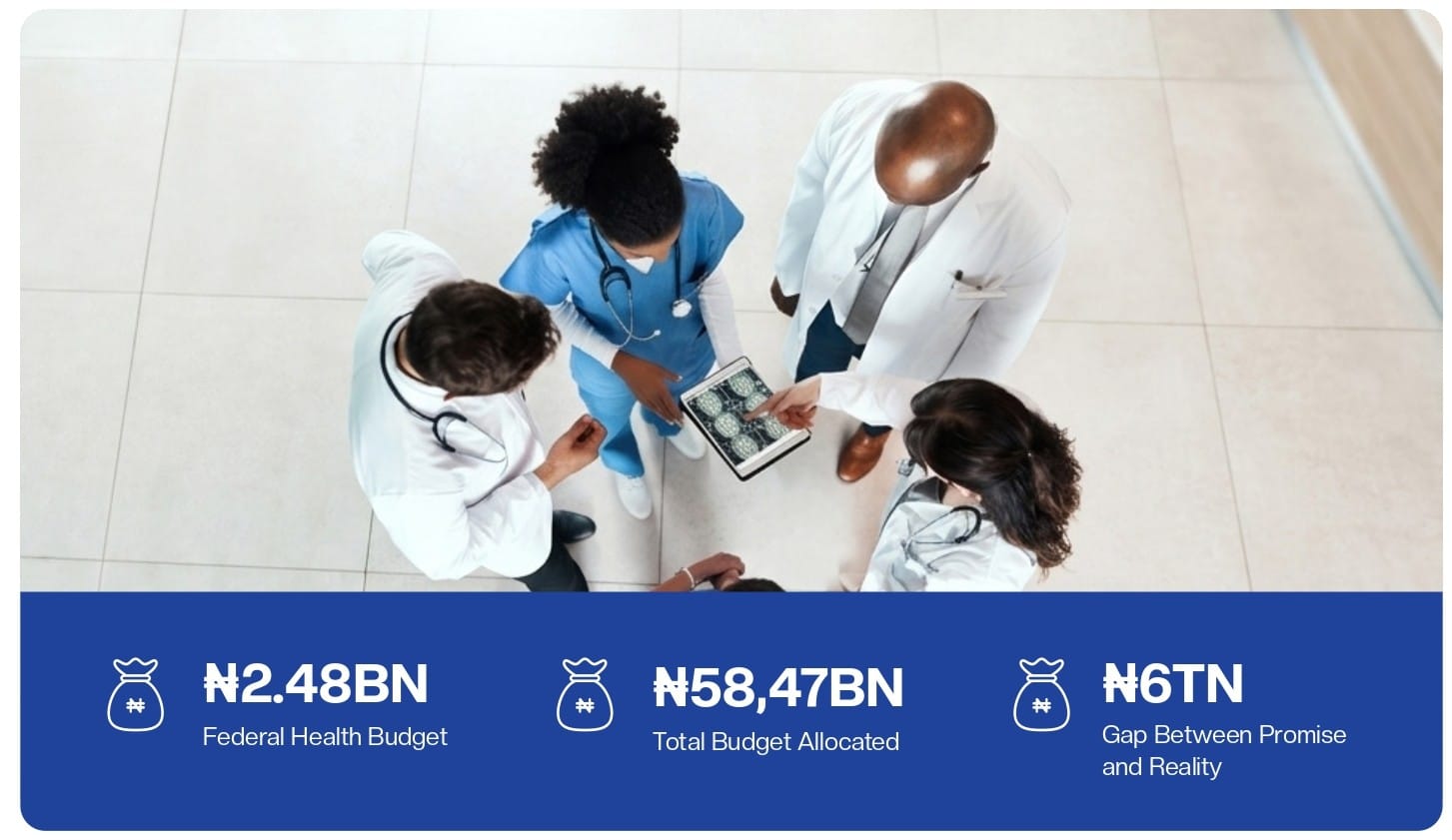
Nigeria’s 2026 federal budget allocates N2.48 trillion to health, which is 4.2% of a N58.47 trillion total budget. Twenty-five years ago, African leaders signed the Abuja Declaration committing to 15% of national budgets for health. We have never met it. Not once, not even during COVID. The funding gap between what was promised and what was delivered in this year’s budget alone stands at over N6 trillion.
Let that number settle.
The problem is not that Nigerians don’t value their health. The problem is that we have not yet built a system worthy of that value.
Meanwhile, Nigerians spent an estimated $2.39 billion on medical tourism in 2024 alone. The same families who cannot access reliable care at home are boarding flights to India, the UK, and the UAE for treatment that should be available here.
Over 16,000 doctors left Nigeria in the last five years. Currently, the country has roughly 3.8 doctors per 10,000 people. The World Health Organization recommends at least 10.5. These are not abstract statistics; they are the arithmetic of a system in distress, and they are felt, every day, by ordinary people in extraordinary pain.